Growpedia for Pros
Tips and Guides from Professionals for Professionals
Tutorials, explanations and expert tips from our Helvetic Seeds professionals! New articles every week!
Tutorials, explanations and expert tips from our Helvetic Seeds professionals! New articles every week!
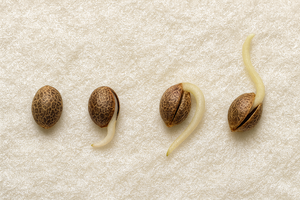
Germination is the biological process in which the dormant embryo inside the cannabis seed becomes activated and begins to grow. This process is primarily triggered by three factors that we control with the paper towel method: moisture, temperature, and darkness.
Imbibition (water absorption): The seed absorbs water through its shell, causing the embryo to swell and activating enzymatic processes.
Enzymatic activity: Enzymes become active and convert stored nutrients into usable energy (sugars), which is required for cell growth.
Radicle breakthrough: Once sufficient energy is available, the radicle (the taproot) breaks through the seed shell. It grows downward and is the visual sign of successful germination.
To maximize the germination rate, materials and environmental conditions must be precisely optimized.
Seed quality: Use only hard, dark brown to brown seeds. Light or immature seeds often fail to germinate.
Water quality: Ideally use distilled or reverse osmosis water to avoid chlorine and minerals. Alternatively, tap water can be boiled and cooled. The optimal pH value is slightly acidic between 5.8 and 6.5.
Paper towels: Choose unprinted, tear-resistant paper towels to ensure no harmful chemicals are released.
Containers: Two clean ceramic plates or a plastic box with a lid work well. The container must retain moisture and block out light.
Temperature control: This is the most important factor. Keep the temperature consistently between 21°C and 25°C. The ideal point is 23°C. Avoid temperatures above 28°C, as they can damage the embryo.
Hydrating the towels: Thoroughly moisten three layers of paper towel with a spray bottle. Gently squeeze out excess water until the towels are wet but not dripping. Place them on the bottom plate.
Placing the seeds: Position the cannabis seeds at least 2 cm apart on the paper towels. Tip: Older seeds can be soaked in a glass of water for 12 hours beforehand to soften the shell.
Covering: Cover the seeds with another three layers of moistened paper towel.
Closing the germination chamber: Place the second plate upside down over the first or close the box. Keep the germination chamber in a warm, dark place.
Daily inspection: Check the setup daily. (Germination typically takes 1 to 5 days, up to a maximum of 10 days.) The towels must remain constantly moist. Mist lightly if necessary. Important: No standing water should collect at the bottom of the plate.
Germination failure (after 10 days): Usually caused by low temperatures, poor seed quality, or oxygen deficiency due to excess water. Slightly increase the temperature if it is below 21°C.
Mold formation: Immediately remove affected seeds. Reduce moisture and improve hygiene.
Root grows into the paper towel: If the root becomes too long, carefully cut around the root with the paper towel still attached and plant it together. Never tear off the root.
The transition into the growing medium is the most delicate moment.
Transplant readiness: The seedling is ready once the white radicle is 1 to 2 cm long and slightly curved downward.
Caution: Handle the germinated seed by the shell. Never touch the delicate white root.
Preparing the substrate: Use low-nutrient seedling soil in small pots. Make a small hole about 0.5 to 1 cm deep using a clean tool.
Planting: Place the seed into the hole with the root pointing downward.
Covering and watering: Lightly cover the seed with soil without pressing it down. Water very gently with a spray bottle. Place the pot under mild light immediately to prevent the seedling from stretching excessively.
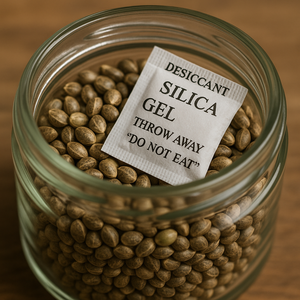
The drier the seeds, the longer they remain viable. Moisture is the biggest enemy of seed storage. Seeds that are stored even slightly moist will begin to mold or rapidly lose their germination potential. Therefore, seeds should be completely dry before storage. Ideally, the remaining moisture should be below 8%. If you're unsure, let the seeds dry at room temperature in a dry place for several days.
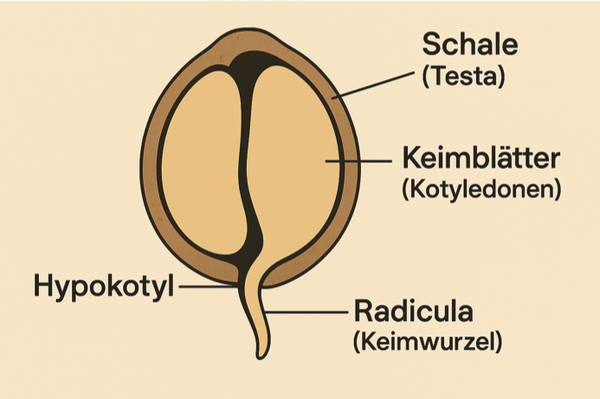
The cannabis seed is the starting point of every cannabis plant and forms the basis for cultivation and propagation. Biologically, a cannabis seed is the fertilized seed of Cannabis sativa, containing all genetic information and the nutrient reserves required to develop a new plant.
A cannabis seed consists of several essential components that ensure its survival and its ability to germinate:
Germination begins when the seed is exposed to optimal environmental conditions. Three factors are crucial:
Once the seed absorbs water, it swells and its metabolic processes activate. The radicle breaks through the shell first and forms the primary root. Soon after, the hypocotyl and the cotyledons begin to rise. Once the cotyledons reach the light, the plant initiates photosynthesis and becomes independent from the nutrients stored in the endosperm.
The germination ability of a cannabis seed is strongly influenced by storage conditions. Excess humidity, temperature fluctuations or exposure to light can damage the delicate biological structures inside the seed and reduce germination rates. When stored correctly, cannabis seeds can remain viable for several years.
Genetics also play a major role: high-quality cannabis seeds come from stable parent plants that have been selectively bred for yield, resilience and cannabinoid profile.
Natural cannabis seeds randomly produce either male or female plants — a process still not fully understood and currently being researched. Learn more in the article “Increasing the Percentage of Female Plants in Regular Seeds.”
For flower production, only female plants are desired, as they produce the resin-rich buds. Therefore, many modern seed lines consist of feminized seeds, which produce almost exclusively female plants.
Unlike clones (cuttings), which are genetically identical to the mother plant, plants grown from seeds show unique genetic variation. This can offer advantages (new, interesting traits) but also risks (instability).
In summary, the cannabis seed is a small but powerful biological unit containing life, energy and the full genetic potential of the cannabis plant. From germination to harvest, every grow begins with this remarkable natural structure.
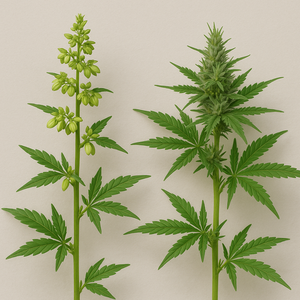
There is strong evidence that the development of male or female cannabis plants is not purely random, but influenced by several internal and external factors. Sex determination in cannabis is complex and depends on both genetic predisposition and environmental conditions.
Each plant carries chromosomal information: Cannabis has X and Y chromosomes, similar to humans.
However, this genetic determination is not absolute, because…
Scientific studies and grower observations show that certain environmental conditions can influence the likelihood of a plant becoming male or female.
Key environmental factors include:
Under stress conditions (light leaks, nutrient problems, physical damage), some cannabis plants develop hermaphroditic traits: they produce both male and female flowers.
This mechanism is a survival strategy that allows the plant to self-pollinate when reproductive opportunities are limited.
The formation of male or female flowers is strongly influenced by plant hormones:
This is why hormones or chemical agents (such as colloidal silver) can be used intentionally to influence the plant’s sex—commonly used in the production of feminized seeds.
Sex determination in cannabis is not purely random but the result of an interplay between genetics and environmental factors. Growers can increase the likelihood of female plants by optimizing environmental conditions and avoiding stress. However, only feminized seeds offer a fully reliable outcome.

Choosing between indoor and outdoor cannabis cultivation is a key decision for every grower. Today, this choice is often influenced by the use of autoflowering cannabis seeds, which flower independently of the light cycle. Each growing method offers clear advantages depending on your goals, budget, and experience level.
Indoor cultivation takes place in a fully controlled environment. Light, temperature, humidity, and nutrient supply can be precisely regulated.
Autoflowering cannabis seeds do not require a switch to a 12/12 light cycle. They can remain under 18–20 hours of light while flowering automatically. This significantly simplifies grow management. Their compact size also makes them ideal for small grow tents and discreet setups.
Outdoor cultivation harnesses the free power of the sun and natural conditions, but it is also exposed to environmental factors.
Autoflowering strains are true game changers outdoors. Because they do not rely on autumn light cycles, they allow multiple harvests per season, for example one in July and another in September. Their short stature (often under 1 meter) makes them much more discreet and easier to hide from unwanted attention.
Greenhouse cultivation combines indoor and outdoor advantages. Natural sunlight reduces costs, while the structure protects plants from harsh weather, pests, and temperature fluctuations.
When paired with autoflowering seeds, greenhouse growing becomes especially effective. Plants benefit from early spring sunlight, mature quickly, and remain protected from summer rain and high humidity.
Choose indoor growing if you want maximum control, top-tier quality, and year-round harvests. Opt for outdoor growing if your goal is to save costs and fully utilize natural resources. In both scenarios, autoflowering cannabis seeds are an excellent choice – particularly for beginners or growers seeking fast, easy, and discreet results.

The legal situation regarding cannabis seeds must be assessed differently in Germany, Switzerland and Austria, especially following recent legislative changes and clarifications of existing regulations. Although hemp seeds generally do not contain psychoactive substances and are therefore not classified as narcotics themselves, their legality often depends on the intended use and national cultivation laws.
With the entry into force of the Cannabis Act (CanG) on April 1, 2024, Germany implemented a fundamental shift in its drug policy. This has a direct impact on the legal status of cannabis seeds.
Overall, the legal situation for cannabis seeds in Germany has been significantly liberalized to allow private home cultivation.
In Switzerland, the legal assessment of cannabis is primarily based on the THC content.
As many international seed banks are unfamiliar with Swiss regulations, it is advisable for Swiss customers to purchase from specialized retailers who are experienced in compliant imports into Switzerland.
Austria takes a comparatively liberal approach to cannabis seeds and hemp cultivation, though important restrictions apply.
In summary, Austria allows the purchase and possession of cannabis seeds. However, the decisive factors are the THC content of the plant and the intent to produce narcotic substances.
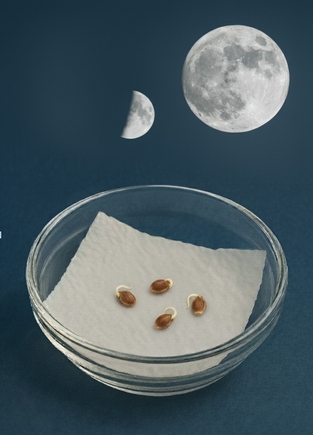
The influence of the moon on the germination of cannabis seeds has been discussed in agriculture for centuries. While modern science has so far provided only limited conclusive evidence, many gardeners and growers strongly believe in the traditional practice of moon-phase gardening.
The moon’s gravity demonstrably affects ocean tides, but its direct impact on plants is considered very small. Reflected moonlight is also extremely weak compared to sunlight and is not sufficient to drive photosynthesis.
However, there are some early experimental indications: a study involving the plant Brassica juncea showed that several nights under full moonlight could trigger changes in metabolism and protein profiles. Whether these effects also apply to cannabis remains unclear.
According to the lunar calendar, germination is most often recommended during the waxing moon. The reasoning behind this is that the “sap flow” in plants is believed to increase during this phase, potentially enhancing water uptake by seeds. Some growers also prefer the full moon, assuming that the maximum level of moonlight and gravitational influence stimulates growth.
Many growers report higher germination rates or stronger seedlings when germinating in alignment with the lunar calendar. Others consider the effect to be purely coincidental and observe no noticeable difference.
What is certain is that following lunar phases does not harm the seeds, provided that fundamental conditions such as warmth, moisture, and cleanliness are properly maintained.
Whether the moon has a measurable influence on the germination of cannabis seeds remains an open question. What is clear, however, is that moon-phase gardening has a long tradition and forms an integral part of many growers’ cultivation philosophies.
Those who wish to try it are advised to start germination during the waxing moon while ensuring optimal germination conditions – as these remain decisive regardless of the lunar cycle.
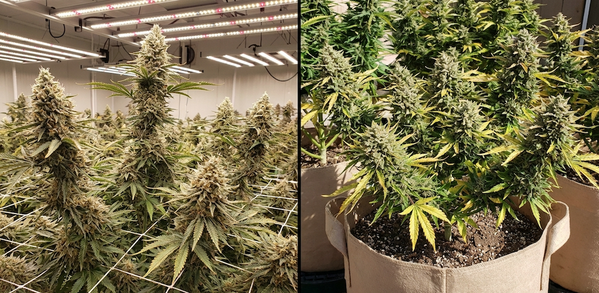
Choosing between autoflowering and photoperiod feminized cannabis seeds is one of the most important decisions in cannabis cultivation. Your choice affects the entire grow process – from cycle length and yield potential to technical complexity and management. There is no universal “better” option – only the one that fits your goals.
Photoperiod strains respond to light duration (photoperiod). During the vegetative stage, they require 18–24 hours of light. To trigger flowering, they need a strict 12 hours light / 12 hours darkness (12/12) schedule. “Feminized” means they produce only female plants.
Autoflower strains contain Cannabis Ruderalis genetics and begin flowering automatically after about 3–4 weeks, regardless of the light schedule. Like feminized photoperiod seeds, they produce only female plants.
Choose photoperiod feminized seeds if:
Choose autoflower seeds if:
Photoperiod cannabis seeds offer maximum control, highest yield potential, and premium quality. Autoflowering seeds stand out for speed, simplicity, and discretion. The best choice depends entirely on your goals, experience level, and growing environment.
Lorem ipsum dolor sit amet, consetetur sadipscing elitr, sed diam nonumy eirmod tempor invidunt ut labore et dolore magna aliquyam erat, sed diam voluptua. At vero eos et accusam et justo duo dolores et ea rebum. Stet clita kasd gubergren, no sea takimata sanctus est Lorem ipsum dolor sit amet. Lorem ipsum dolor sit amet, consetetur sadipscing elitr, sed diam nonumy eirmod tempor invidunt ut labore et dolore magna aliquyam erat, sed diam voluptua. At vero eos et accusam et justo duo dolores et ea rebum. Stet clita kasd gubergren, no sea takimata sanctus est Lorem ipsum dolor sit amet.
Willkommen in unserer Growpidia – deiner Wissensquelle für Cannabis-Anbau. Hier findest du Expertenwissen für optimale Ergebnisse, egal ob Anfänger oder Profi.
Willkommen in unserer Growpidia – deiner Wissensquelle für Cannabis-Anbau. Hier findest du Expertenwissen für optimale Ergebnisse, egal ob Anfänger oder Profi.

For over 15 years, experts from California and Spain have been breeding potent, THC-rich cannabis strains with high resistance to diseases for medical and hobby users.

Sie wollen zum ersten Mal Cannabis anbauen, wissen aber nicht, wo Sie anfangen sollen? Um Ihnen bei der Wahl der richtigen Samen zu helfen, haben wir dieses spezielle Angebot von Cannabissamen für Anfänger zusammengestellt.

Zertifizierte Hanfsamen für Profis: Hochwertige Sorten für maximalen Ertrag. Entdecken Sie unser EU-gelistetes Saatgut für Faser, Korn und CBD – legal und sicher anbauen.

Lorem ipsum dolor sit amet, consectetur elit. Integer ac purus sed nulla tempus. Donec vitae magna, non rutrum urna.
.png?w=600/format=webp)
Lorem ipsum dolor sit amet, consetetur sadipscing elitr, sed diam nonumy eirmod tempor invidunt ut labore et dolore magna aliquyam erat, sed diam voluptua. At vero eos et accusam et justo duo dolores et ea rebum. Stet clita kasd gubergren, no sea takimata sanctus est Lorem ipsum dolor sit amet.
Lorem ipsum dolor sit amet, consetetur sadipscing elitr, sed diam nonumy eirmod tempor invidunt ut labore et dolore magna aliquyam erat, sed diam voluptua. At vero eos et accusam et justo duo dolores et ea rebum. Stet clita kasd gubergren, no sea takimata sanctus est Lorem ipsum dolor sit amet.